SEMICONDCUTORS BASICS AND DEVICES
Definition:
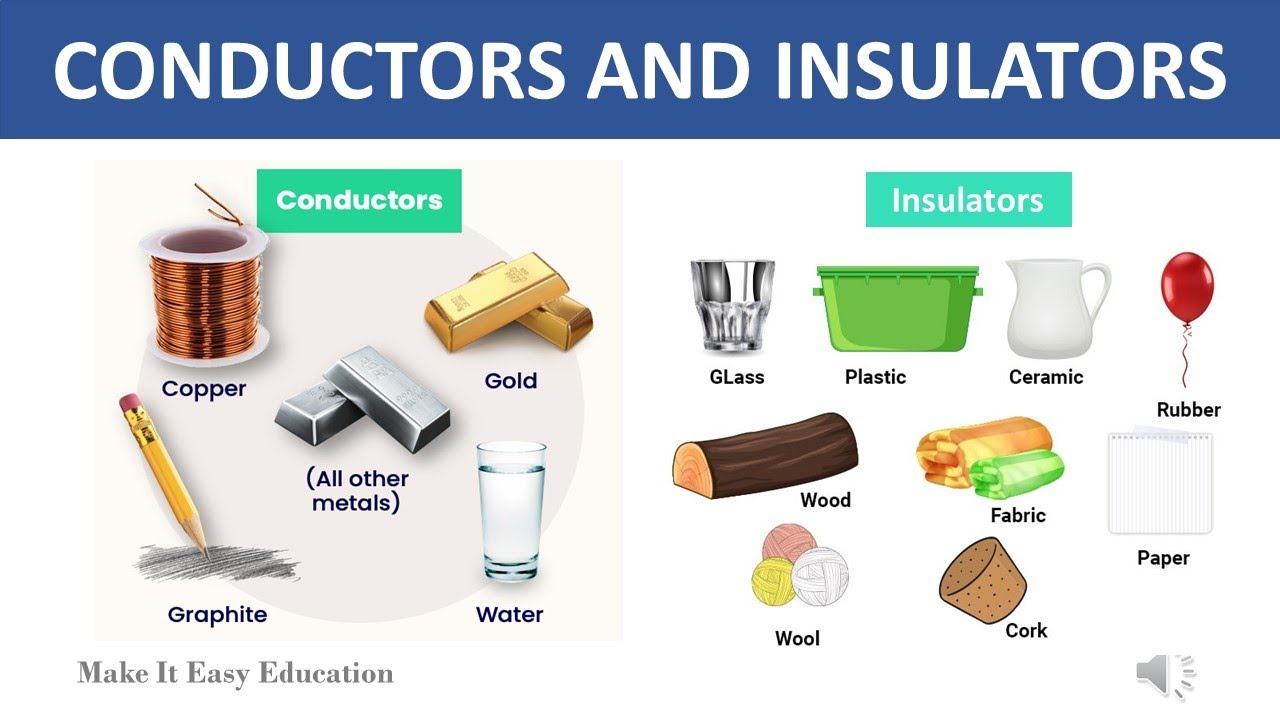
Conductors are materials that allow electric current to flow easily through them due to the presence of a large number of free electrons.
Characteristics:
- They have low electrical resistance, which means they oppose very little current flow.
- They have a large number of free electrons in their atomic structure, which can move freely when an electric field is applied.
- Conductors typically have 1 or 2 valence electrons in their outermost orbit, making them easy to detach and move.
Examples:
- Metals like Copper (Cu), Silver (Ag), Gold (Au), and Aluminum (Al) are excellent conductors.
- Electrolytes (salts dissolved in water) and plasma can also conduct electricity.
Applications:
- Conductors are used in wiring, power transmission lines, electrical circuits, and in components like connectors.
Definition:
Insulators are materials that do not allow electric current to flow through them easily due to the absence of free electrons.
Characteristics:
- They have high electrical resistance, which means they strongly oppose the flow of current.
- Electrons in insulators are tightly bound to their atoms, so they cannot move freely.
- Insulators have full valence shells (typically 8 valence electrons), making it very difficult for electrons to escape.
Examples:
- Rubber, Glass, Plastic, Wood, and Ceramics are common insulators.
Applications:
- Insulators are used as coating materials for wires, in circuit boards, and as protective layers to prevent electric shocks.
Definition:
Semiconductors are materials that have conductivity between that of a conductor and an insulator. They partially allow current to flow, depending on external conditions like temperature, light, or the presence of impurities.
Characteristics:
- Semiconductors have 4 valence electrons in their outermost shell (e.g., silicon and germanium).
- At absolute zero temperature, semiconductors act like insulators because no free electrons are available.
- When energy (e.g., heat or light) is applied, electrons gain enough energy to break free from their atoms, allowing conductivity.
- The electrical properties of semiconductors can be modified by doping (adding impurities) to enhance their conductivity.
Examples:
- Silicon (Si) and Germanium (Ge) are the most commonly used semiconductors.
- Gallium Arsenide (GaAs) and other compound semiconductors are used in specialized applications like LEDs.
Applications:
- Semiconductors are the foundation of modern electronics, used in devices like transistors, diodes, microprocessors, and solar cells.
| Property | Conductors | Insulators | Semiconductors |
|---|---|---|---|
| Conductivity | Very high | Very low | Moderate (between conductors and insulators) |
| Resistance | Very low | Very high | Varies with external conditions |
| Valence Electrons | 1-2 electrons | 8 electrons (full shell) | 4 electrons |
| Electron Movement | Free electrons move easily | Electrons are tightly bound | Electrons are free when energy is applied |
| External Influence | Unaffected | Unaffected | Conductivity changes with temperature, light, or doping |
| Examples | Copper, Silver, Gold | Rubber, Glass, Plastic | Silicon, Germanium, Gallium Arsenide |
A diode is an electronic device that conducts electricity only in one direction. It is a component widely used in modern-day electronics. In this article, we will learn about diodes, their properties, symbols, types, and other details.
A diode is made up of two words:
- "Di" means Two
- "Ode" means Electrodes
This indicates that a diode is a device with two electrodes (i.e., cathode and anode).
- A diode is an electronic device having a two-terminal unidirectional power supply, meaning it allows current to flow only in one direction.
- Diodes are widely used in modern-day circuits to:
- Protect circuits from over-voltage.
- Convert AC (Alternating Current) to DC (Direct Current).
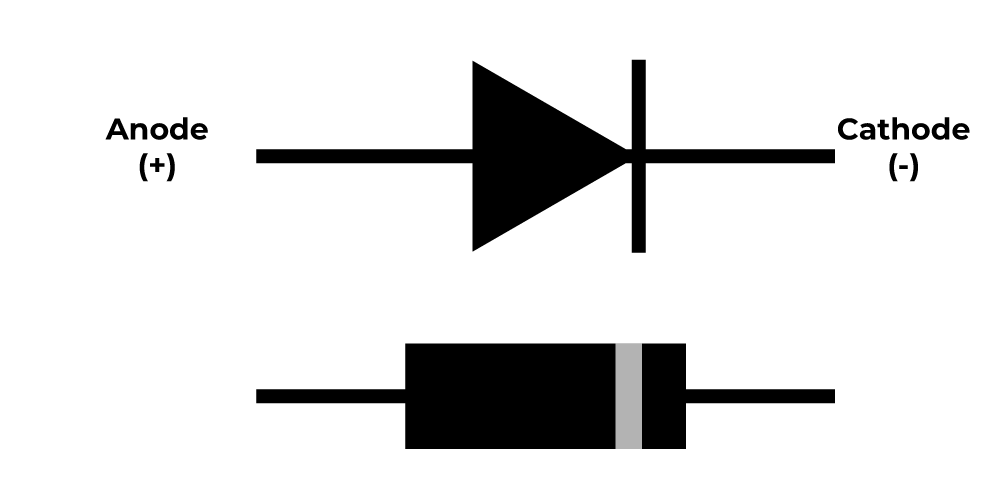
Diodes are represented using special symbols. The symbol for a standard diode is shown below:
-
A diode has two terminals:
- Anode (positive terminal).
- Cathode (negative terminal).
-
The arrowhead symbol represents the anode, and the other end represents the cathode.
-
Current flows from anode to cathode in the forward bias condition.
There are various types of semiconductor diodes, widely used in different applications in daily life. Some common types are:
-
Definition:
LED is the most useful type of diode. When connected in forward bias, the current flowing through the junction produces light. -
Applications:
- Widely used as bulbs for providing light.
- Found in display systems and indicators.
-
Definition:
Also known as rectifier diodes, these are used for the rectification process.- Made up of two layers:
- P-type semiconductor material.
- N-type semiconductor material.
- The combination forms a P-N junction.
- Made up of two layers:
-
Current Flow:
- Forward-biased condition: Allows current to flow.
- Reverse-biased condition: Blocks current.
-
Applications:
Used in power supplies for converting AC to DC.
-
Definition:
A type of diode that:- Allows current to flow in the forward direction.
- Works in reverse bias for voltage regulation.
-
Characteristics:
- Heavily doped P-N junction diode.
- Operates effectively in reverse bias conditions.
-
Applications:
Used in voltage regulation circuits to maintain a stable output voltage.
-
Definition:
A special type of P-N junction diode designed to operate in low-voltage regions (0.15 to 0.4 volts). -
Characteristics:
- Optimized for maximum performance at low voltage.
- Low forward voltage drop.
-
Applications:
Commonly used in rectifier applications.
-
Definition:
This type of diode exhibits a variable capacitance based on the voltage applied across it. -
Characteristics:
- Operates as a P-N junction diode.
- Preferred for applications requiring capacitance tuning.
-
Applications:
Used in frequency modulation circuits and RF tuning systems.
-
Definition:
A diode that generates current when light energy falls on it. -
Characteristics:
- Operates in reverse bias conditions.
- Sensitive to light, allowing it to detect and convert light into electrical signals.
-
Applications:
- Used in solar cells, photometers, and other light-sensing applications.
A light-emitting diode (LED) is a semiconductor device that emits light when an electric current flows through it. When current passes through an LED, the electrons recombine with holes emitting light in the process. LEDs allow the current to flow in the forward direction and blocks the current in the reverse direction.
